


1. What Is a Super App?
A Super App is a single digital platform that brings multiple services together under one application, identity, navigation experience, and technology platform.
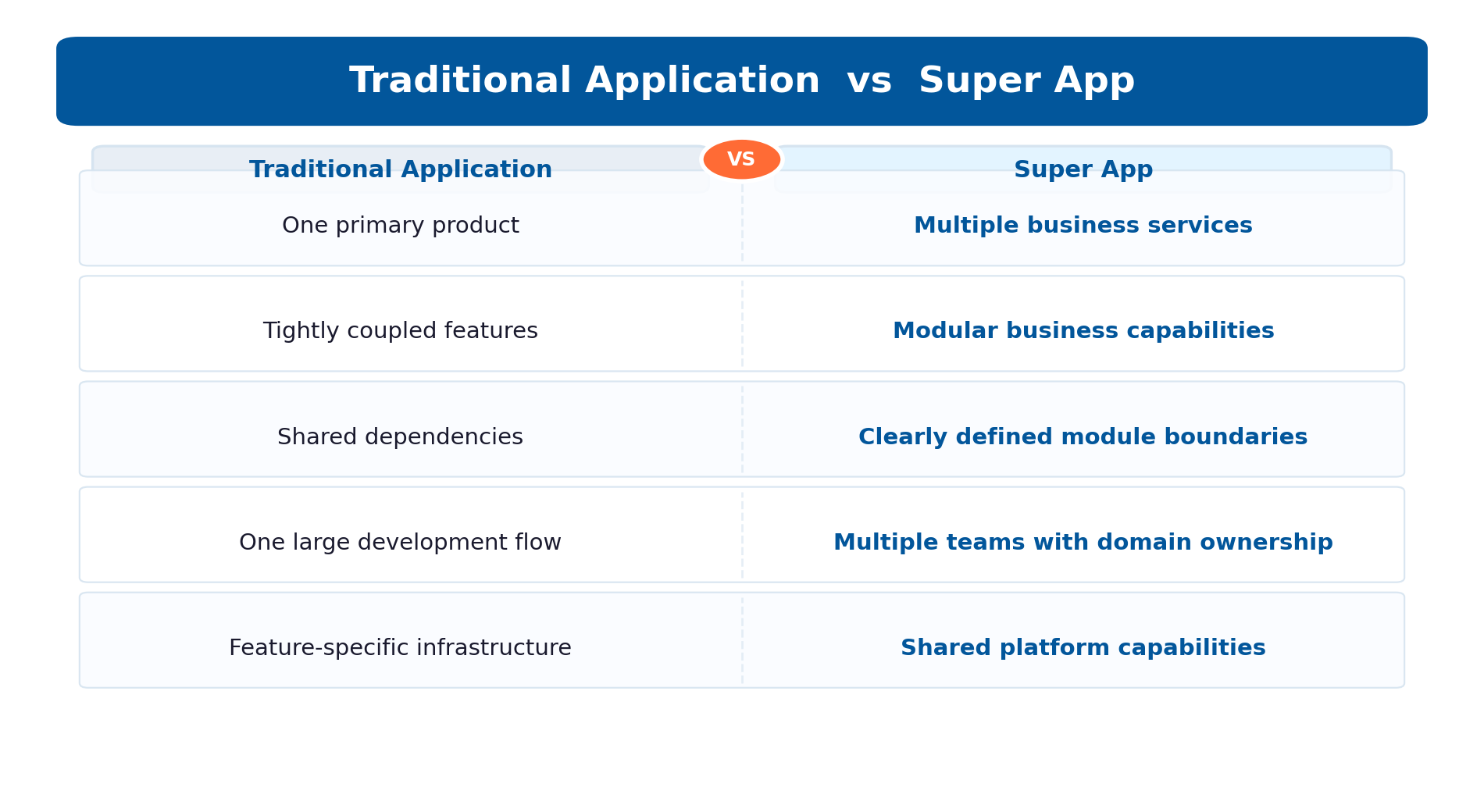
For users, it provides one app, one identity, and one consistent experience.For engineering teams, it provides a shared platform with modular business capabilities that can be developed and maintained by different teams.
Examples of Super App models include Grab, WeChat, Gojek, Alipay, Paytm, and PhonePe, where multiple services are available through a unified application experience. Grab, for example, combines transportation, food, payments, and financial services within its ecosystem.
2. Why Move Toward a Super App?
As products and engineering teams grow, applications can become difficult to maintain because of duplicated services, tightly coupled features, and increasing release complexity.
A Super App architecture addresses these challenges through:
-
-
- Clear module boundaries
- Shared platform services
- Standard development practices
- Centralised authentication and navigation
- Feature flags and controlled rollouts
- Reusable design and technology components
-
The objective is not simply to put more features into one application. It is to create a platform that allows new business capabilities to be added without unnecessarily increasing the complexity of existing features.
3. Core Characteristics
A scalable Super App typically provides:
-
-
- Unified identity — authentication, session management, and user profile.
- Application shell — common navigation, lifecycle, configuration, and startup management.
- Modular business capabilities — payments, investments, insurance, rewards, commerce, etc.
- Shared platform services — networking, analytics, storage, security, notifications, and logging.
- Cross-service navigation — consistent navigation and deep-linking.
- Controlled delivery — feature flags, configuration, and staged rollouts.
- Defined communication contracts — APIs, events, and interfaces between modules.
-
4. Flutter Super App Architecture
A Flutter implementation can separate the application into a Platform Layer and independent business modules.
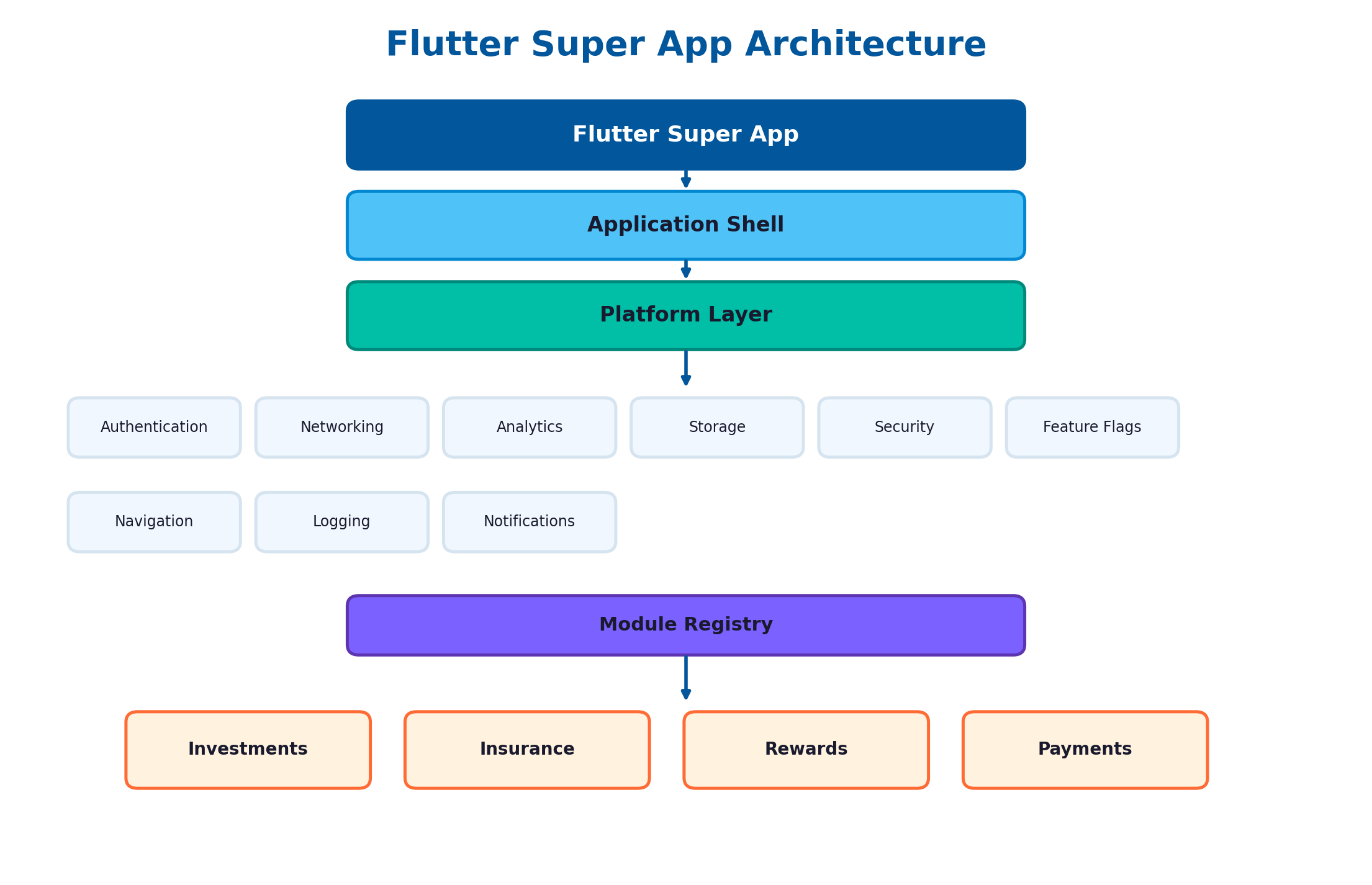
Each business capability can be implemented as an independent Flutter package or feature module while consuming common platform services.
Within a module, a consistent architecture can be used:
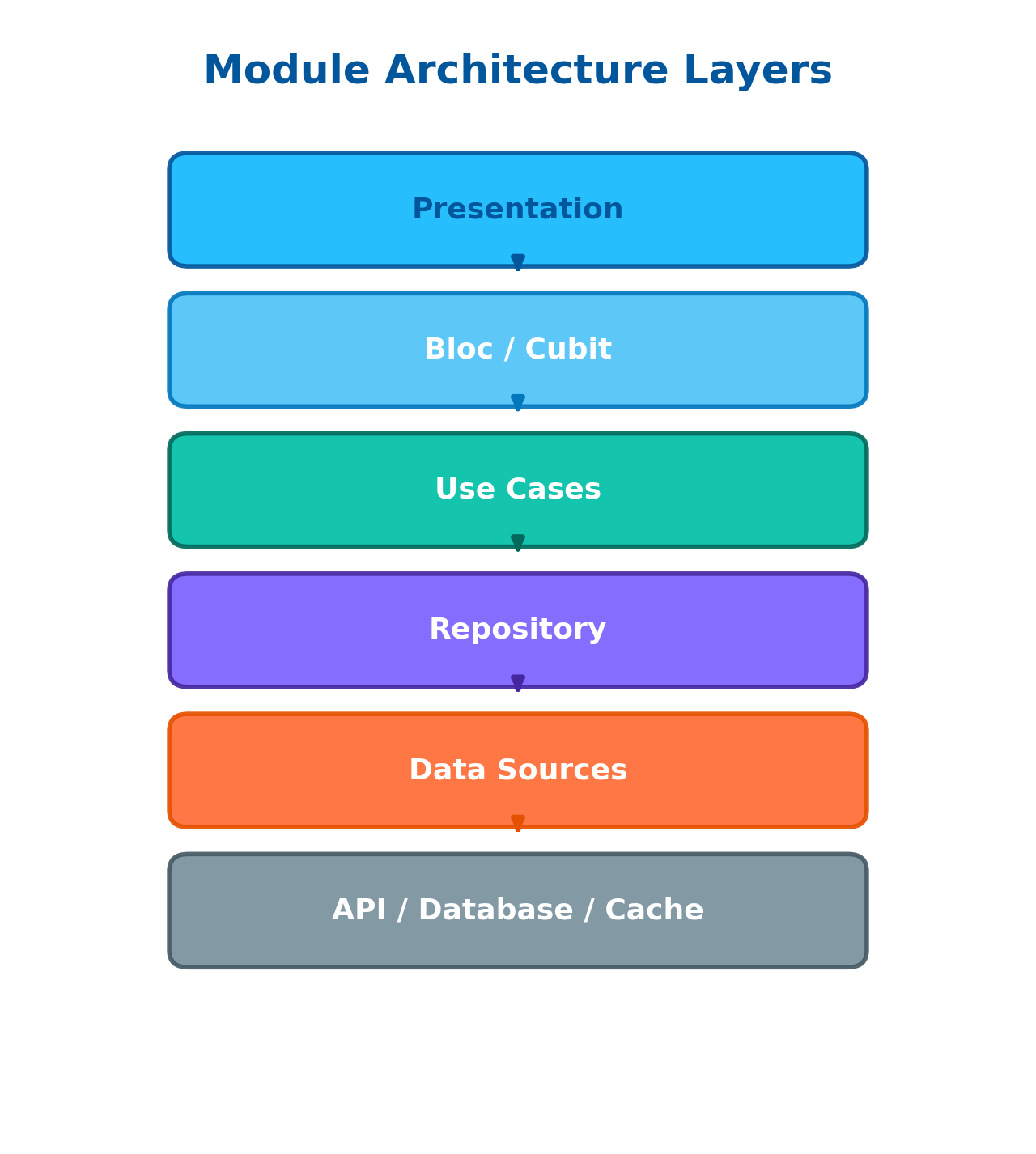
This separation improves maintainability, testability, onboarding, and consistency across teams.
5. Platform SDK
A shared Platform SDK provides capabilities that should not be independently implemented by every business module.
Typical capabilities include:
-
-
- Authentication and session management
- Networking
- Secure and local storage
- Analytics and logging
- Feature flags and configuration
- Notifications
- Deep linking
- Error handling
- Crash reporting
- Shared utilities
-
The Platform SDK should remain focused on cross-cutting capabilities. Business-specific logic should remain inside the relevant business module.
6. Module Registration and Startup
A Super App should avoid initialising every business capability during startup.
A typical startup flow is:
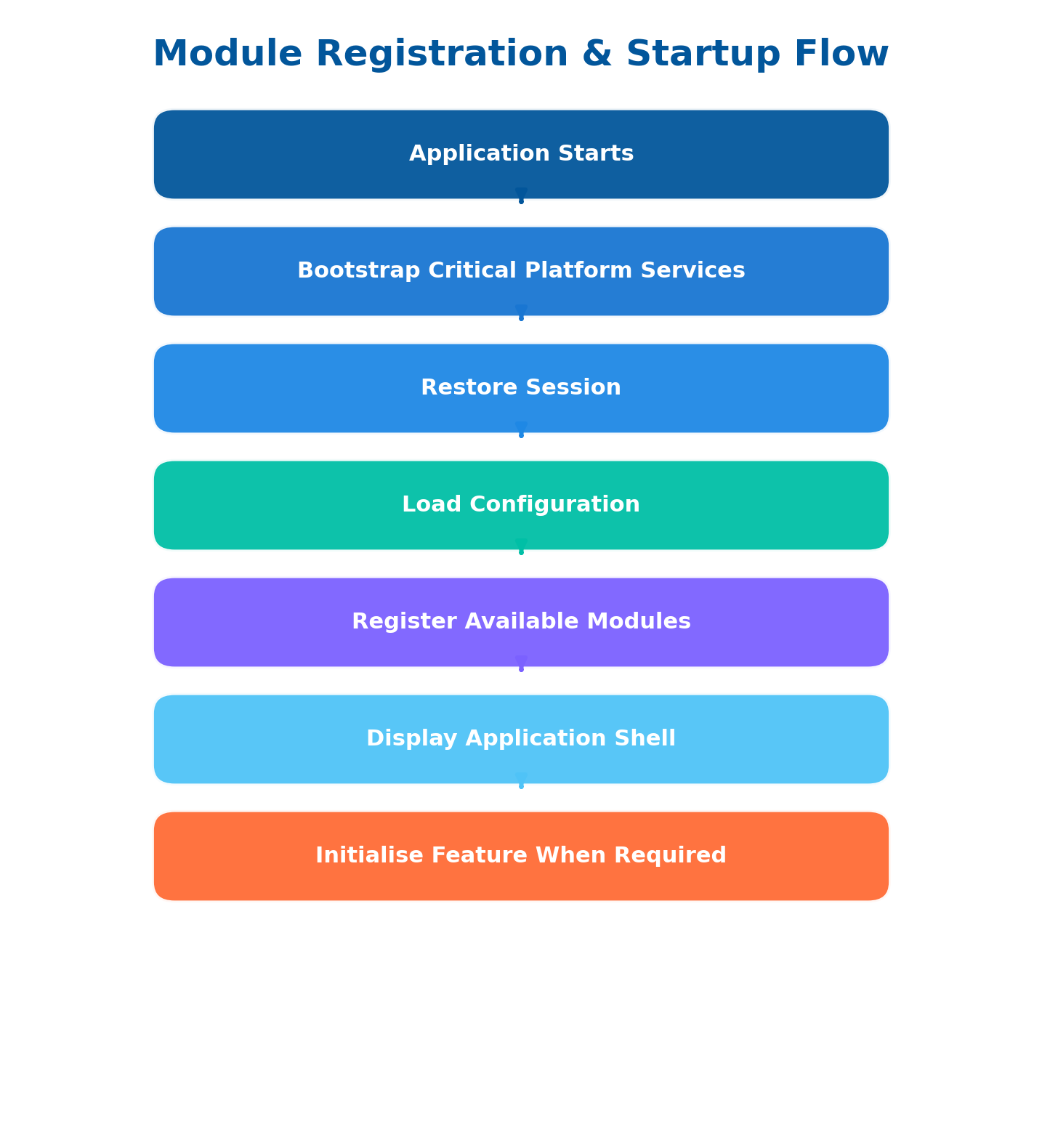
A module can expose a standard contract for:
-
-
- Routes
- Dependencies
- Feature configuration
- Analytics
- Initialization
-
This creates a predictable way to introduce new capabilities.It is important to distinguish module registration and lazy initialization from downloading new application code at runtime. Flutter supports deferred components for Android and web, but this capability should not be represented as universal runtime module deployment across all platforms.
7. Event-Driven Communication
Modules should avoid unnecessary direct dependencies on each other.
For example:
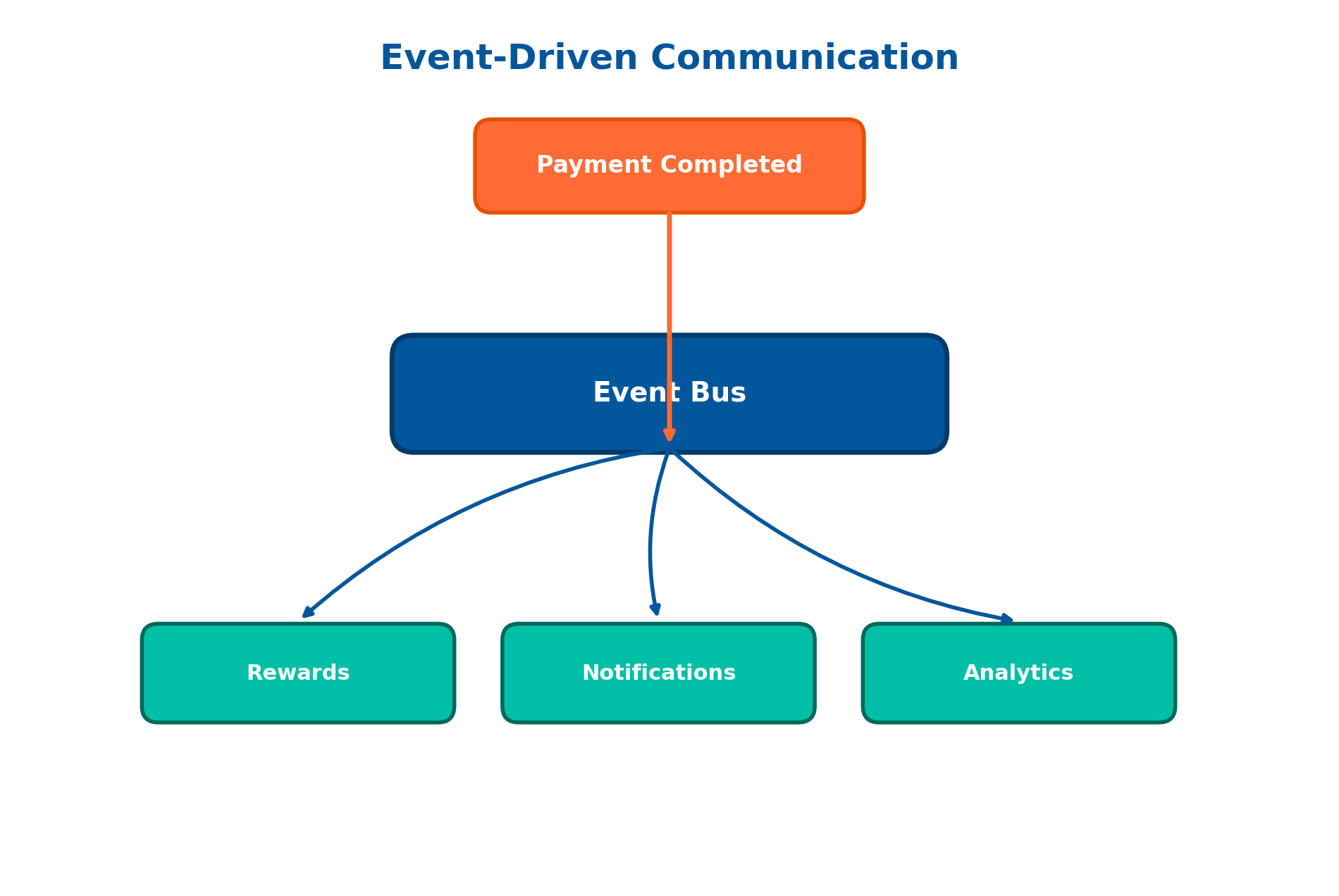
An event-driven approach can help reduce coupling when multiple modules need to react to the same business event. However, an Event Bus should not replace APIs or direct contracts where a synchronous response or strong transaction boundary is required.
8. Shared Design System
A common Design System ensures a consistent experience across the Super App.
It can provide:
-
-
- Typography
- Colours
- Spacing
- Buttons
- Forms
- Cards
- Dialogs
- Navigation components
- Accessibility guidelines
- Animation standards
-
Business modules should consume these shared components instead of creating their own versions.
9. How This Compares With Real Super Apps
Modern Super Apps combine multiple services while sharing common platform capabilities.
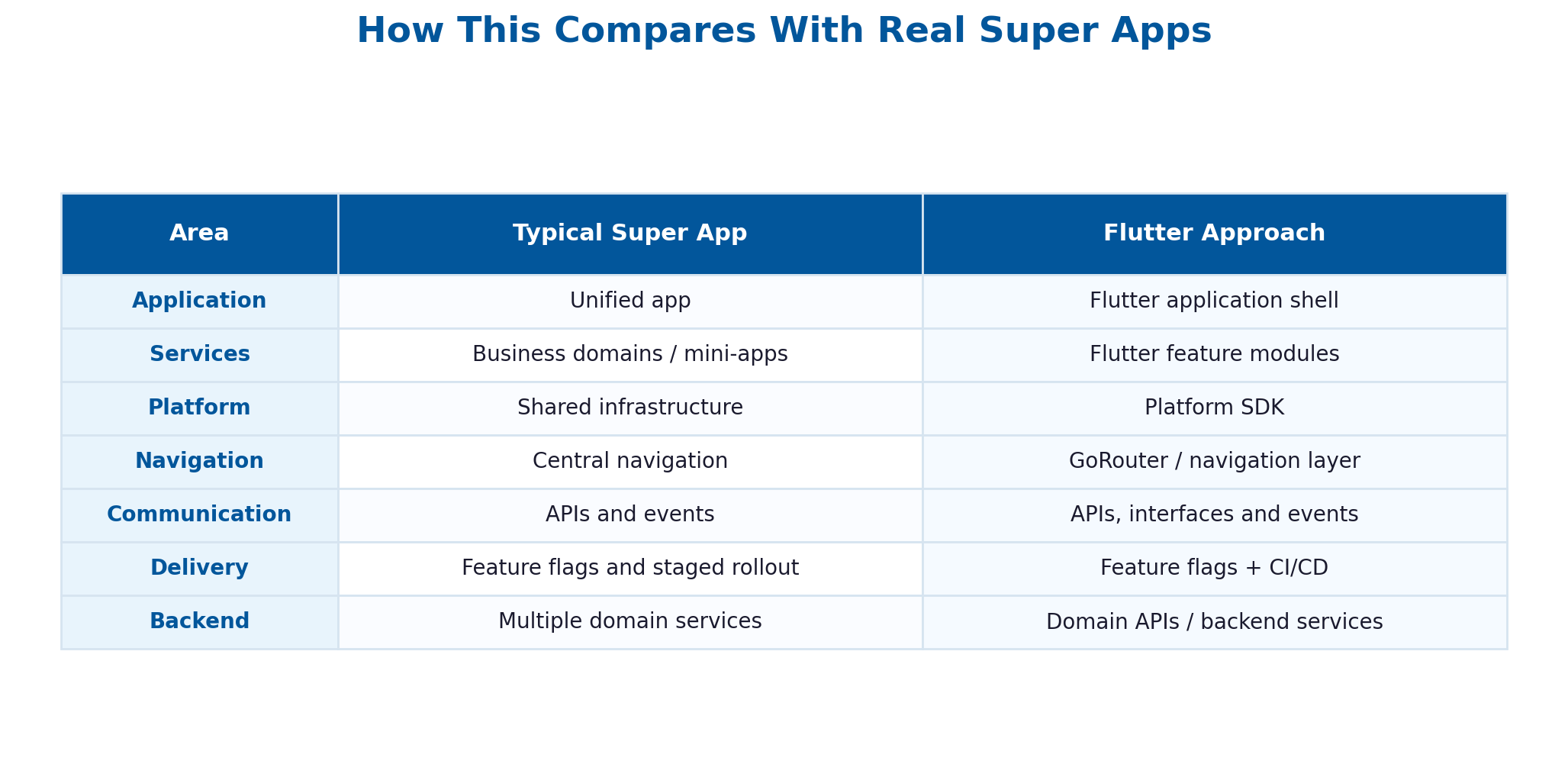
The implementation technology may differ, but the architectural principles remain similar: modularity, shared infrastructure, clear contracts, controlled communication, and a unified user experience.
10. Performance and Scalability
Super App performance becomes increasingly important as the number of modules grows.
Key practices include:
Startup
-
-
- Initialise only critical services at startup.
- Run independent initialization tasks in parallel where appropriate.
- Defer non-critical work.
-
Modules
-
-
- Initialise module-specific services when required.
- Avoid unnecessary cross-module dependencies.
- Cache appropriate data.
- Prevent unnecessary widget rebuilds.
-
Platform
-
-
- Keep shared infrastructure lightweight.
- Avoid duplicate services.
- Standardise module registration and communication.
-
Flutter also recommends minimising expensive work during widget builds and provides mechanisms such as deferred loading for supported platforms.
Key metrics should include:
-
-
- Application startup time
- Module initialization time
- Memory usage
- API latency
- Application size
- Rendering performance
-
The objective is to increase business capabilities without proportionally increasing application complexity and runtime overhead.
Conclusion
A Flutter Super App is more than a large Flutter application containing many features. It is a platform architecture that allows multiple business capabilities to evolve while sharing common infrastructure. By combining modular Flutter packages, a Platform SDK, standard module contracts, controlled event-driven communication, feature flags, lazy initialisation, and a shared Design System, organizations can create a scalable foundation for multiple products and teams.
The technology may differ from the mini-app or native architectures used by some large Super Apps, but the fundamental goal remains the same: One unified experience for users. One shared platform for engineering. Multiple business capabilities that can evolve independently.